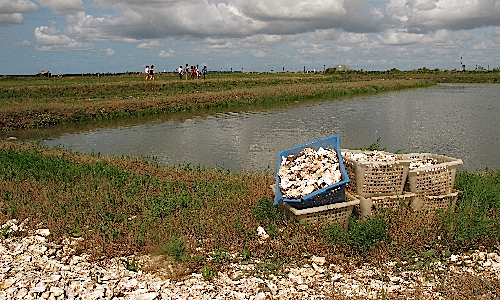
This article visits a corner of south west France where a group of minor rivers were developed to produce a series of navigable river sections, making it easier to carry heavy loads over long distances.
This was achieved with great skill, causing minimal interference to the surrounding countryside. Work started on sections of the Charente and the Boutonne marshland navigations in the middle ages. With regular dredging the waterways became easily navigable, although declining boat numbers in recent years have allowed the weeds to to grow back. It is still navigable, even when compared to its heyday in
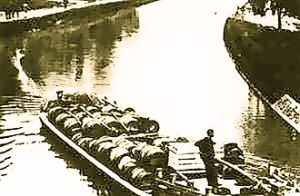
Barrels of wine from Sète arriving on a gabare
the latter days of the 18th century (17xx) . France was at the height of its maritime power, commanding a large fleet of warships – and despatched squadrons of frigates as the need arose. The brave sailors who sailed on them often spent three
to four years at sea in difficult conditions. It was common for sailors to be lost at sea ; some were washed overboard ; others were taken ill and did not recover ; some just never went home because for whatever reason, they found themselves in a country they liked, or they found a port where they could live without being persecuted, or they had set up a new home and started another family.
The part of France that I am writing about today is in the south west of the country, where my wife, Michelle, was born and
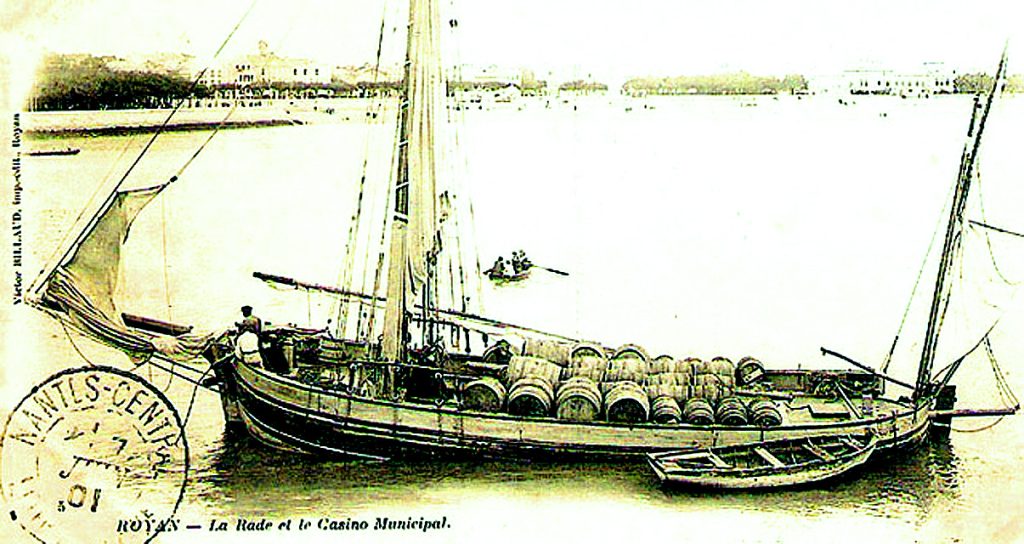
Gabare in Royan harbour, 1901. Note lack of tourists…
spent her early years. A group of rivers flow down gentle valleys, a patchwork of vineyards and wooded hillsides. The largest is the Charente, a long, sinuous river which rises not far from Angoulême. Its biggest tributary is the Boutonne, which emerges, full size, from a hillside, overlooking marshlands. The Boutonne feeds the extensive marshlands, joining the Charente down stream of Saint Jean d’Angély, which was an important commercial focus at this time. The marshlands were hard to navigate, but the people who lived in the ancient département of Aunis kept dredging the channels in a regular pattern, at the times specified by the elders.The craft they used for all their needs was called a gabare, a 20-metre flat-bottomed barge. The wooded hilltop ridges that clung to the sky provided timber of all sizes, from beams to charcoal, which was also made by the local foundries for all sorts of ironware.You are unlikely ever see an old-fashioned gabare since they were often little more than consignments of timber lashed up with a steering oar. They could take cargo, but as a shared risk. These ad hoc lash-ups made a single trip downstream. Once any cargo had been taken off, the gabares were delivered to the shipyards as timber and used to make ships of the line. Today, a gabare is a simple flat bottomed boat, with a canopy to shelter tourist groups of 20 to 30 people.
All manner of things passed through the riverside wharves on the Boutonne and the Charente, such as cannon for the king’s shipyards. The two big rivers were joined by the Seigné and the Né. Further south, the river Seudre flows north west into the top end of a tidal corridor linking Fort Boyard to the north and the Gironde estuary in the south. These rivers are not long, starting around Limoges and flowing west north west to reach the Atlantic some 50 miles downstream at Rochefort, where the king had a series of naval shipyards and a ropemaking machine. In the seventeenth century (starts 1601, finishes 1699) it was one of Europe’s major maritime powers. These minor rivers literally powered a large and extensive economic engine that travelled the world, planting its language, culture and economic structures as it went.
Today, much of central Africa is francophone (speaks French), likewise a huge swathe of the Panote:cific islands, not forgetting that some French speaking settlers stayed on the coasts of the Americas, (north and south) having migrated for better fishing.
Translation note
Une fleuve and une rivière se traduisent vers l’anglais avec le même mot : “river” tous les deux. Une fleuve se jette dans la mer; une rivière jette son eau dans un lac ou une autre rivière ou même dans une fleuve. La fleuve aura automatiquement un zône où le niveau d’eau est variable suivant la marée. Il y a quelques rivières avec une masse suffisante pour ateller la force gravitationnelle de la lune, mais pas toutes.