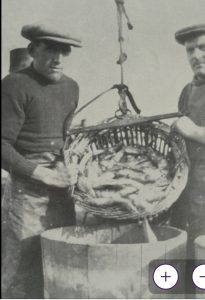
 Scottish fishermen working in the North Sea from the from the 18th century onwards, adopted the cran basket as a measure of fish on the quayside; a full cran of herring weighed 56 stone and was usually spread across four quarter cran baskets. (56 stone = 56 x14 divided by 2,2 kilos) The quarter cran basket became a legalised trading measure in Scotland during the 19th century, followed by England and Wales in 1908.
The cran was first and foremost a volumetric unit, fixed in trading regulations at 37.5 imperial gallons, although dockside traders often needed to know the number of fish in a basket. While most quarter cran baskets held about 1,200 fish, the differing sizes and weights in arriving consignments ranged from around 700 fish (rare) to almost 2,000 (juveniles). For a piece count, there is no quick alternative to opening the basket.
The baskets were cylindrical with just a hint of a bulge: they were supplied in whole cran, half cran and quarter cran sizes. The basket weaver wove a foot into each cran, so that every base stood solidly on the deck, crowding around the fishermen who were waiting for the seine nets to be brought inboard and emptied on the deck. The first task was to ensure that all the weevers were removed from the flailing mass of gasping fish. A weever is a very small fish, not more than three or four inches long, if that. Their spiny backs have venomous stings that can kill an unwary man in minutes. The deck crew sort and gather the catch, most of it is herring, bound for the smokehouses. Before the quarter cran baskets are filled, they are moved to the unloading area on the deck. Once again, the skill of the basket weaver is put to the test: a quarter cran basket holds on average seven stone (7stone = 7×14 divided by 2.2 kilos) of fish. The baskets are topped with a solidly woven rim. They are unloaded using a small steam-powered crane and of specially shaped pair of clips to hold the basket until they land on the quayside with a gentle scrunching noise. Soon to be smoked as kippers, some of this catch would have been sent to London by train overnight, arriving just in time for breakfast at a gentlemens’ club.
 The NFU’s next director general is an experienced food industry management figure. Sophie Throup joins the National Farmers’ Union in May, bringing with her years of board level experience, notably as Head of Agriculture at Morrisons. Raised on her family farm in Yorkshire, her working life reflects her commitment to food production. “My roots have always been in agriculture, and I know how important this period of change is for the sector,’ she told journalists when her appointment was announced.