Urban Food Chains

the links between diet and power

Advertisement

Colbert and economic crisis

Screenshot

Jean-Baptiste Colbert (1619-1683*) was in his early 40s in 1661, when Louis XIV appointed him Comptroller of the French navy – along with a handful of related posts. Managing the accounts for the French fleet was particularly toxic. A quick look at the French state’s solvency track record suggests that it was less than perfect. The king’s choice of Colbert senior was timely, if nothing else. Colbert kept the post until he  died in 1683, adding to a formidable reputation in the process.

He actively supported the national economy, making sure that his staff monitored duty on imports that could be produced more economically in France

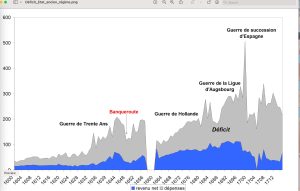
The fact that Colbert senior spent a lot of time overseeing construction projects in his later years should not be taken as evidence of the French state’s ability  to pay. The country’s fragile finances were not out of place alongside it’s continental rivals. Started around 1600, the Tours  Livre was a sub-regional institution. Look at the y-axis on the graph at the top of this page. which is denominated in “Tours livres” – and plots the relative tax yields one of a collection of metal-based regional currencies used in the middle ages for shared investments over modest areas. The Tours livre and contemporaries of its ilk were in use from about 1600 until the first quarter of the 18th century. After a near catastrophic collapse following the return of William and Mary, finance ministers realised why there weren’t more of these currency baskets in operation. Basically, there were no restraints on royalty.

Colbert senior used his strong networking skills to back and build food market halls the length and breadth of the Hexagon. Known as “le grand Colbert”  he promoted a form of mercantilism (dubbed “colbertism”), while spending a lot of time on capital-intensive projects such as groups of four dry docks served by a single lock for    naval shipbuilding and repairs. By placing an order for a 374 metre-long rope machine to supply the dockyard in 1666, Louis XIV ensured the success of Colbert’s plans for Rochefort and generated strong demand for French-grown sisal and hemp for years to come. Rope-making was the  the key to the increasing complexity and manoeuvrability of navalfleets: it was normal use as much as 30 miles (56km) for even a small ship. Drinking water was a knotty problem, however, until the late 19th century. To complicate matters, Rochefort had  no readily accessible water supplies, despite intensive foraging. In 1808, Napoleon ordered a full scale search for water in Rochefort After years of searching, in 1868 a hapless team of diggers finally broke through a hard rock dome that had been holding back an underground reservoir of super-heated boiling salt water**. Later developed as a thermal bath site, the problem of supplying drinking water remained intractable and dogged the city for years to come.

  •  Readers need to know that Jean-Baptiste Colbert (1619-1683) had a son, Jean-Baptiste Colbert* (1651-1690, Marquis de Seignélay) Given the frequency of first names passing from one generation to the next, it is important to keep track of the generation markers when they are cited by a significant number of sources, as here. It is also useful to keep any asterisks that other researchers might have added, even if your own investigations might suggest that they are superfluous: once removed, they will forever prey on your productive time (caveat editor…).

** A kettle will boil at atmospheric pressure, reaching a temperature of  around 100 degrees C. If you leave it to boil, the water will continue to boil at 100 degrees, expelling water vapour to balance the surplus heat.   Put a heavy duty closure on the kettle and the pressure inside the vessel will rise quite rapidly, as will the temperature. This rising pressure and temperature is what moved steam engines: it is an example of superheating at work. Do  not try this at home unless you have a qualified engineer to fit and monitor a pressure gauge…
Have gabarre, will trade

This article visits a corner of south west France where a group of minor rivers were developed to produce a series of navigable river sections, making it easier to carry heavy loads over long distances. 

This was achieved with great skill,  causing minimal interference to the surrounding countryside. Work started on sections of the Charente and the Boutonne marshland navigations in the middle ages. With regular dredging the waterways became easily navigable, although declining boat numbers in recent years have allowed the weeds to  to grow back. It is still navigable, even when compared to its heyday in

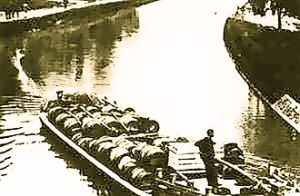
Barrels of wine from Sète arriving on a gabare

the latter days of the  18th century (17xx) . France was at the height of its maritime power, commanding a large fleet of warships – and despatched squadrons of frigates as the need arose. The brave sailors who sailed on them often spent three

to four years at sea in  difficult  conditions. It was common for sailors to be lost at sea ; some were washed overboard ; others were taken ill and did not recover ; some just never went home because for whatever reason, they found  themselves in a country they liked, or they found a port where they could live without being persecuted, or they had set up a new home and started another family.

The part of France that I am writing about today is in the south west of the country, where my wife, Michelle, was born and

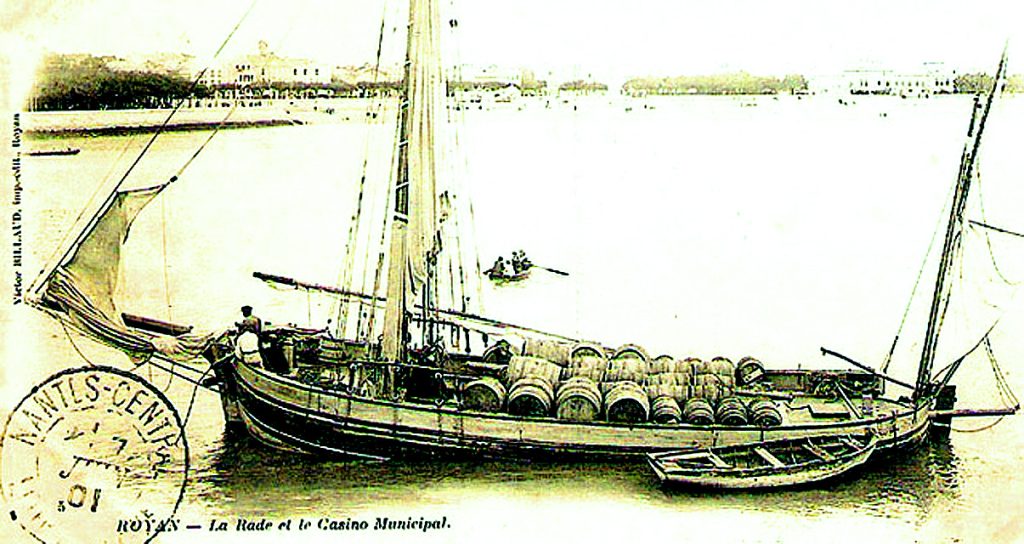
Gabare in Royan harbour, 1901. Note lack of tourists…

spent her early years. A group of rivers flow down gentle valleys, a patchwork of vineyards and wooded hillsides. The largest is  the Charente, a long, sinuous river which rises not far from Angoulême. Its biggest tributary is the Boutonne, which emerges, full size, from a hillside, overlooking marshlands. The Boutonne feeds the extensive marshlands, joining the Charente down  stream of Saint Jean d’Angély, which was an important commercial focus at this time. The marshlands were hard to navigate, but the people who lived in the ancient département of Aunis kept dredging the channels in a regular pattern, at the times specified by the elders.The craft they used for all their needs was called a gabare, a 20-metre flat-bottomed barge. The wooded hilltop ridges that clung to the sky provided timber of all sizes, from beams to charcoal, which was also made by the local foundries for all sorts of ironware.You are unlikely ever see an old-fashioned gabare since they were often little more than consignments of timber lashed up with a steering oar. They could take cargo, but as a shared risk. These ad hoc lash-ups made a single trip downstream. Once any cargo had been taken off, the gabares were delivered to the shipyards as timber and used to make ships of the line. Today, a gabare is a simple flat bottomed boat, with a canopy to shelter tourist groups of 20 to 30 people.

All manner of things passed through the riverside wharves on the Boutonne and the Charente, such as cannon for the king’s shipyards. The two big rivers were joined by the Seigné and the Né. Further south, the river Seudre flows north west into the top end of a tidal corridor linking Fort Boyard to the north and the Gironde estuary in the south. These rivers are not long,  starting around Limoges and flowing west north west to reach the Atlantic some 50 miles downstream at Rochefort, where the king had a series of naval shipyards and a ropemaking machine. In the seventeenth century (starts 1601, finishes 1699) it was one of Europe’s  major maritime powers. These minor rivers literally powered a large and extensive economic engine that travelled the world, planting its language, culture and economic structures as it went.

Today, much of central Africa is francophone (speaks French), likewise a huge swathe of the Panote:cific islands, not forgetting that some  French speaking settlers stayed on the coasts of the Americas,  (north and south) having migrated for better fishing. 

Translation note

Une fleuve and une rivière  se traduisent vers l’anglais avec le même mot : “river” tous les deux. Une fleuve se jette dans la mer; une rivière jette son eau dans un lac ou une autre rivière ou même dans une fleuve. La fleuve aura automatiquement un zône où le niveau d’eau est variable suivant la marée. Il y a quelques rivières avec une masse suffisante pour ateller la force gravitationnelle de la lune, mais pas toutes.

Fresh ideas for food?

Food production can appear chaotic at first sight, but  those doing tbe heavy lifting have a fair grsp of what is required.  More to the point, even if it may not be immediately obvious, there will usually  be a number of integrated systems monitoring crucial  processes. Take canned foods, for instance. The underlying technology is an oversize pressure cooker, which has been in constant use since Denis Papin invented what came to be known as the Papin digester in the latter half of the 18th century. Down the intervening centuries canning technology improved dramatically, not that anyone who was not involved with the day to day minutiae of contemporary products  would ever have guessed. There is more than a touch of national pride surrounding the lives and work of such industry demigods as Nicolas Appert; Antoine-Augustin Parmentier;Louis Pasteur. Here are  a few examples of the genre: French inventions, capital F ; French national pride in its canners is very commendable, but overlooks a few small but significant glitches.

Skip to toolbar