
 For France’s parliamentarians, 1993 ended with some progress, but without a readily identifiable outcome. To be sure, national legislation had got a better grip on the systematic abuses of commercial practice, but there remained a lot of work to finish before anyone would be able to say they had anything solid to show for it. The French government focussed on the work of a parliamentary commission led by Jean-Paul Charié, the député for Loiret, which shares its name with an upstream tributary of the river Loire. Sadly, Charié did not live to see the fruits of his work, but his input was invaluable, especially in the way he could summarise and implement new national expectations for commercial propriety.
Urban Food Chains
the links between diet and power

France needed laws to protect its citizens… but now it’s too late

Philippe SEGUIN at a meeting with UPE members in the 1990
Times change: it is no longer considered smart to be dismissive of liberty and the rule of law. In 1993, the leader of the French parliament, Philippe Séguin implored his colleagues at the Palais Bourbon to double down on sharp commercial practices. He was addressing members of the elected lower house of the French parliament at the start of a root and branch review of the country’s commercial law for the food industry. Nowhere else in the national economy was it so important to establish and protect a body of people that would both protect current legislation yet still allow business and industry to develop and extend free trade in positive ways.
“Managing a balanced set of rules for free competition is only possible when there is full a
greement on a legal framework that will protect and develop equitable trading, while still allowing lawmakers to legislate with precision and firm resolve to prevent any future damage.”
Restoring damaged sectors, building the trust for future developments and protecting the weak from the predations of the rich and powerful are just three tasks still waiting for French lawmakers

.
Preserving a free trading environment is an important and basic requirement for our country, Séguin declared.
Where there’s muck, there’s knowledge
 This year sees the eightieth birthday of France’s top agronomist, Marc Dufumier (fumier = manure in French) who served as the head of AgroParisTech from 2002 until his retirement in 2011. “What’s in a name? ” you ask… An earthy sense of humour, perhaps? Happy birthday, Sir.
Winners and losers in 2025

Strong Christmas sales: Lidl

Isolated locations: Co-op

Struggling: ASDA
The UK food industry is facing a period of chaos and change. At the beginning of the year, Wakefield-based Morrisons warned of extensive store closures and job losses. The group’s remaining fish, butchery and cheese counters are set to go, along with other added value categories. While Morrisons’ sales showed a 3.1% increase in the four weeks before Christmas, it is unlikely to prevent a fire sale of added value categories and a review of procurement priorities. The decline in the multiple’s commercial performance in recent months point towards a long term decline. So far this year, Morrisons has announced the closure of its Rathbones Bakery business, with a predicted 115 job losses: more can be expected to follow as the year progresses. It would be logical for middle grade management to be updating CVs and for senior management grades, along with board members, to be checking the scope of their their NDAs and how much wriggle room they have, if any, in the event of an unscheduled career move..
There are concerns, too, for the future of the Co-op.The chain has announced 19 store closures, which will be completed by the summer. Three sites will be leased out to B+M and the remaining 16 will be taken over by Sammy, a regional chain. The disposals will include stores in Norfolk, Leicestershire, the West Midlands, Nottingham and South Yorkshire. The Coop started the year with more than 2,200 outlets, many of them small, local supermarkets or c-stores. Closures would leave some significant gaps in the UK retail landscape and re-open questions over what can be considered viable. Like ASDA, the Co-op is struggling with significant debt problems and handed over its once thriving banking business to a debt management consortium. Given that Aldi is planning to open 80 stores over the next two years, it may be in a position to insist on favourable treatment when cherry picking underperforming sites from struggling competitors.
Christmas sales figures are still regarded as a long term indication of the profitability of retail businesses for the coming months. Tesco banked its largest surge in seasonal takings for December 2025, while Lidl, Sainsbury and Waitrose reported solid gains in December food sales. With a good number of retailers earning good margins with premium fresh food ranges, ASDA’s return to selling mainstram brands at discounted prices is a dated strategy. The return of Alan Leighton to his old firm suggests that the original problems were not addressed the first time round, which also begs the question of whether it will work the second time around. More than a generation after the original rollback, it is time to ask how many of the first rollback customers are still alive, let alone shopping for food. The ASDA demographic can be used to support a short to medium term reliance on brands with an appetite for older consumers, but the same data also makes a stronger case for building a strong rapport with younger consumers with young families. Younger customers would help to build a stronger future for the business, over a longer time span.
Turning up the volume
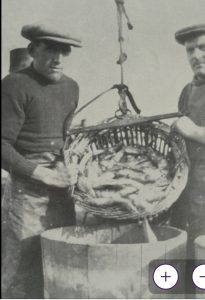 Scottish fishermen working in the North Sea from the from the 18th century onwards, adopted the cran basket as a measure of fish on the quayside; a full cran of herring weighed 56 stone and was usually spread across four quarter cran baskets. (56 stone = 56 x14 divided by 2,2 kilos) The quarter cran basket became a legalised trading measure in Scotland during the 19th century, followed by England and Wales in 1908.
The cran was first and foremost a volumetric unit, fixed in trading regulations at 37.5 imperial gallons, although dockside traders often needed to know the number of fish in a basket. While most quarter cran baskets held about 1,200 fish, the differing sizes and weights in arriving consignments ranged from around 700 fish (rare) to almost 2,000 (juveniles). For a piece count, there is no quick alternative to opening the basket.
The baskets were cylindrical with just a hint of a bulge: they were supplied in whole cran, half cran and quarter cran sizes. The basket weaver wove a foot into each cran, so that every base stood solidly on the deck, crowding around the fishermen who were waiting for the seine nets to be brought inboard and emptied on the deck. The first task was to ensure that all the weevers were removed from the flailing mass of gasping fish. A weever is a very small fish, not more than three or four inches long, if that. Their spiny backs have venomous stings that can kill an unwary man in minutes.
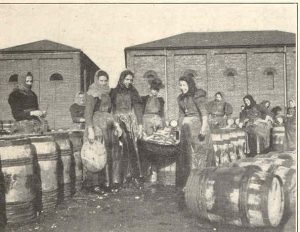 The deck crew sort and gather the catch, most of it is herring, bound for the smokehouses. Before the quarter cran baskets are filled, they are moved to the unloading area on the deck. Once again, the skill of the basket weaver is put to the test: a quarter cran basket holds on average seven stone (7stone = 7×14 divided by 2.2 kilos) of fish. The baskets are topped with a solidly woven rim. They are unloaded using a small steam-powered crane and of specially shaped pair of clips to hold the basket until they land on the quayside with a gentle scrunching noise. Soon to be smoked as kippers, some of this catch would have been sent to London by train overnight, arriving just in time for breakfast at a gentlemens’ club.
Lifetime in food
 The NFU’s next director general is an experienced food industry management figure. Sophie Throup joins the National Farmers’ Union in May, bringing with her years of board level experience, notably as Head of Agriculture at Morrisons. Raised on her family farm in Yorkshire, her working life reflects her commitment to food production. “My roots have always been in agriculture, and I know how important this period of change is for the sector,’ she told journalists when her appointment was announced. NFU members have frequent problems when dealing with multiple retailers, since food producers are not automatically the supplier named on the documentation. This seemingly minor distinction makes an important difference, since food retailers will stone wall and refuse to engage with any party that is not explicitly named on the account details. Quite apart from being very frustrating, this can make some contracts unworkable. This may be a deliberate tactic used by the retailer, or it may be used to stress test a supplier. Time sensitive crops and activities are particularly vulnerable to such practices, since person or party that has to deliver the product has no way of knowing where the real problem arises. Retail logistics will often assume that all categories are time sensitive and place a 20-minute window on deliveries, particularly store deliveries, to keep sites moving, even if the products themselves are stable.
Gratuitous ill will
DEFRA has announced changes to entry checks for High Risk Feed Not (of) Animal Origin (HRFNAO) They took effect on January 1.
Britain imports about half its food, and has been a food importer for centuries. As a collection of islands, the British Isles (which does not include Ireland, by the way) is vulnerable to naval blockades when at war. The same holds in peace time, when it makes sense to offer competitively-priced port facilities. The Brexit preparations included a charge for imported goods to drive off the ferry and cross the marshalling yard, to leave the port. This thinly-disguised daylight robbery is called the Common User Charge (CUC) and gives those people with power in the UK government an opportunity to harass port operators around the country, without having to own up scoring an own goal.
In its early drafts, the CUC was expected to cost £100 or less; then less than £150. Every time the CUC charges were modified or increased, the DEFRA civil servants cranked up their revenue expectations. Exporters to the UK had trouble finding out when the CUC would be coming into force and, more worryingly, what they could expect to pay to use British ports.
The UK has a very diverse port sector, owned and operated by all sorts of organisations and businesses. Trading structures with centuries of history rub shoulders with modern commercial operators. Take a port like Dover, the entry point for the lion’s share of the UK’s food imports.
The port was ganted a royal warrant in 1604 by James I, which transferred it to the town of Dover. It has been managed by a port trust ever since, until today it is one of the country’s largest ports.
Ever since James signed Dover’s royal warrant, the town has had a free hand to manage and operate its port facilities as it sees fit. The crown has been excluded from the site — and it would appear that the UK government deeply resents the status quo. In a spectacular display of ill ill, DEFRA has taken the opportunity to take a side swipe at the businesses that pay good money to use the port.
In mid-April, HMRC set a cat among the pigeons, announcing that CUC invoices would not be sent out until the end of July, just as the charge comes into force. Frantic enquiries from over-stretched company accountants went on to reveal that there would be no reference field on the CUC invoices that would enable invoices to be reliably checked against manifests before they are invoiced. To make matters worse, HMRC also informed importers that CUC invoices would revert to a four-week billing cycle, on July 30, when the first flush of CUC will also fall due, thereby engineering chaos for no good reason.
This deliberately provocative carry-on has fed a festering grudge. Like most ports run by a private trust in the UK, Dover is barred from using facilities and equipment as collateral when the port needs to raise money for capital investment. This requires an act of parliament. And a measure of tact.