Urban Food Chains

the links between diet and power

Advertisement

Every one of them is different

Sky News is currently streaming an overview of British farming (https://news.sky.com/story/it-keeps-me-awake-at-night-can-british-farming-survive-13132220) which raises a number of questions that have been dodged for years and are coming home to roost with a certain inevitability. They are as predictable as ever, as intractable as ever and demand answers as urgently as ever. The only certainty is that the farming sector faces a crisis which has been ignored for years and will no longer wait in an orderly queue.

The first thing that needs to be made clear at the outset is that there is no such creature as an average farmer. The Sky presentation is very careful to choose visually tame representatives of a sector that  is universally misunderstood. Sky’s lead journalist on this reporting, the west of England and Wales correspondent Dan Whitehead, would doubtless agree that despite the rapidly falling numbers of farmers in Britain, there is no such creature as an “average” farmer anywhere in the world.

The industrial world develops and markets a range of specialist vehicles and technology for a sector that has as many solutions for its many technical challenges as it has practitioners. The general public, in Britain and further afield, has no problem synthesising a stereotype notion of a nonexistent rural world. In the process, any suggestion of  a viable business model  runs counter current to the town dweller’s vision of a rural idyll.

It would not be productive to imagine that rural businesses are complementary to industrial or urban economic structures. Nor can the transport and distribution networks that link urban consumers to an imagined rural hinterland ever ensure that each business gets what it needs in a timely manner.

A frequent town dweller’s  notion of a farm is more like a zoo than a production unit. Go back a century or so to George Orwell’s Animal Farm and you encounter a group of anthropocentric livestock: hens, pigs, cattle and heavy horses. Truth to tell, if it ever existed, this diverse community of livestock was a casualty of the first world war. The two million British equine casualties had a greater impact on warfare and industry than the loss of several millions of military personnel or civilians killed in air raids elsewhere. British army officers were required to supply a horse’s  front hoof when reporting an equine casualty, whereas they did not need to furnish any such grisly evidence for human casualties among their ranks.

The wartime massacre of draft horses was beyond the breeding capacity of the northern hemisphere and cleared the way for mechanisation in both rural hinterlands and metropolitan centres alike. The British army bought in horses from as far away as North America, but they were ill-suited to military requirements.

Both agriculture and industry have exhibited huge appetites for energy during the past two centuries. The combined effects of converting the plains of North America into a grain exporter on a continental scale. This was accompanied by the relentless westward advance of the railroads through the 1850s and 1860s, hauling wheat back to the east coast and shipping it on to Europe. 

The age of steam put bread on the tables of starving cities. It may even have given urban populations a passing curiosity as to where food comes from and what sort of people might produce it. But the only people that ever had contact with producers and consumers were traders with a limited interest beyond crop forecasts and spot prices. It is hardly surprising that during the intervening decades, a parallel web of dreams fed on pictures in books and magazines should inhabit part of the cultural vacuum between town and country. 

Dan Whitehead’s rural narrative assembles facets of the  agricultural world as a kaleidoscope might do. He starts by talking to Welsh sheep producer Rhodri, who has seen a 40% cut in his income, now shorn of subsidy. He is worried that his school age son will not inherit the family farm.

Outdoor pork producer Jeff laments the supposed passing of the British pig industry. Like many British pig producers, he believes his European counterparts are subsidised as generously as they have ever been. He can’t go into a supermarket without spotting foreign meat: pork chops from Spain, chicken from Poland and Brazil. He can sum up Brexit in one word: “atrocious”. From his farm in Kent,  Jeff drove a tractor up London for a city centre protest. Like many in the pig sector, he is adamant that breeders have been thrown under a bus by a government that doesn’t care. “There’s an  unfairness in British agriculture,” he argues. Looking at the deals the UK government signed with Australia and  New Zealand, he might have a point.

Nearby, fruit grower Tim has built up a strawberry business valued in tens of millions of pounds. He needs a workforce of 2000 to pick thousands of tonnes of strawberries. Most of his recruits are from EU member states. When the UK was in the single market, workers could move  freely with no time limits. Now they are limited to six months and have to move on regardless of whether or not they are a net gain or a net drain on their employer. Tim is frustrated because he cannot negotiate prices for his crop from a solid position. 

There are plenty of British pig producers who will argue that foreign pigmeat is hindering domestic producers, but the story is a little bit more subtle than that. If British producers could earn a living off the sales of pork loins, they would cheerfully do so. Since loins are used for roasting joints or bacon, there will always be buyers for this cut. This often leads to a situation whereby British loin are sold through for roasting joints. Meeting demand for bacon packers, there is a steady trade in pigs from Dutch and Danish units. These have been raised to British standards for decades and are effectively competing on a level field, even if their British counterparts see it differently. The key to staying in business is referred to as balancing the carcase, ensuring that every saleable part of the carcase is sold. Hams or gammons are straightforward to prepare for the retail market and represent a good return. What British pig breeders often overlook, however, is that they will routinely export forequarters to cutting halls in northern Europe, which have skilled workforces that make short work of the technically challenging forequarters. These are home to the animal’s powerful jaw muscles. If a pig bites your hand, count your fingers as soon as you’ve stemmed the bleeding.

245% duty shock for UK cheese

British cheese exports to Canada will face duty of 245% next year, once the third country duty-free quota is exhausted. Some 95% of this quota is already taken by products arriving from Norway and Switzerland, leaving very little for shipments to any other third country.

This slap in the face for British cheesemakers comes as Canadian negotiators came amid talks on the implementation of the much-vaunted bilateral trade deal. Refusing to roll over previous extensions to zero percent duty available under former EU terms, the so-called cheese letters, the decision vapourises pre-Brexit claims of extensive growth in UK food exports. These will in fact be treated like any other third country products, in the absence from specific terms agreed during the framework negotiations. Last year, the UK exported cheese worth nearly GBP 19 million to Canada.

Growing concern

Hundreds of acres of cultivable farmland will be cleared to make way for houses as far as the eye can see. In the coming months, Mid Sussex District Council will hear applications from developers wanting to build 1500 houses between the villages of Ansty and Cuckfield. As well as residential properties, there will be shops and amenities in addition to a headline-grabbing 30% allocation of social housing. Whether or not the developments will ever release as much as 30% for social housing remains to be seen, but it needs to be there at the outset..

This major development plan faces problems, however. To begin with the new homes will generate additional demand for water in a part of the world where demand for water is already comparabl;e to desert regions.The loss of 250 acres of farmland is nothing short of disastrous: the UK cannot afford to throw away productive land.

Hard cheese

Irish dairy farmers are seeing huge falls in demand and output in the wake of Brexit. The Irish Creameries’ Suppliers Association ICMS this week revealed that this was an ongoing situation and not a passing phase. Not surprisingly, the ICMS has some very substantial members who between them exported more than 80,000 tonnes of block Cheddar a year to the UK. Allow 13 tonnes of milk to make a tonne of Cheddar and store it for a year or two at a creamery, and it adds up to a significant business commitment.

Those with long memories will remember former farm minister Liz Truss regaling the 2014 Tory party conference with a hatchet job on British cheese imports. Surprisingly little change from today’s outbursts, really. Shows how little she learnt at DEFRA.

Value or price?

Today’s On Your Farm came from Yew Tree Farm, Bristol’s last city farm. Third generation farmer Catherine Withers faces existential challenges to a business that has adapted to extensive and rapid change, but is on the point of losing access to land that is vital to its survival. Part of a site of Scientific and Conservation Interest, the farm should have been spared the predatory attention of a local property developer.

Click the screengrab to access the programme on the BBC.

Instead, acres of hay and winter feed once intended for Catherine’s dairy herd is under lock and key. The tenancy on the field concerned was terminated in favour of a planning proposal for 200 homes that has yet to be agreed. When the BBC visited, the hay in the field was ready to be cut and the livestock would have been sure of winter sustenance. However, Catherine is kept away from her crop by a heavy padlock on the gate. Being able to see the crop but not gather it in just adds injury to insult.

Elsewhere on the farm, another tenancy on a field adjacent to a local council crematorium is set to end, as the town hall plans to extend the amenities for its residents. Again, it is the dairy cattle that will lose out. Catherine has a small dairy herd, as well as outdoor pigs: she also grows vegetables, which she can sell to local residents within walking distance of her farmhouse. Bristol used to have more than 30 farms within its boundaries: as the city’s only remaining farmer, Catherine is something of a local hero, not just to her customers.

Yew Tree has a high proportion of ancient meadow in its grazing, an irreplaceable asset that has been quietly sheltering threatened flora and fauna for centuries. Its value to Bristol is incalculable, but depends on being an integrated space, across which wildlife can roam. The shift from viable and productive to long term decline is an ever-present threat and determined by factors that neither Catherine nor her many supporters can control.

Listen to the programme while it is available on the BBC Sounds website. It raises questions for all of us, regardless of whether we live in a city or a rural area.

Day and night

For centuries urban populations have cheerfully ignored one of the most basic phases in the rhythm of the planet’s life, thanks to rapidly evolving technology. It is paradoxical, but completely normal, for millions of people around the world to treat the hours of day and night as interchangeable. In the twenty first century, the electric light switch rewrites all the rules governing what can be done at different times of day. For all practical purposes, such rules have no current application.

City life is 24/7, thanks to artificial lighting. A trivial gesture over a light switch is all many of us need to turn night into day. But this has not always been the case and if we make any serious progress with choking off climate change, we will have to rethink our energy expectations, too.

Before the widespread use of electric light, the availability of town gas pipes determined the extent of street and domestic lighting in industrial towns and cities. Go back a century and the demand for animal fats and oils to make candles and run lanterns was significant, if waning. But go back further and a gaping chasm re-appears between those who lived in sparsely-lit houses and those who could afford to routinely light their homes and entertain guests to dinner or dance the night away at elaborate balls.

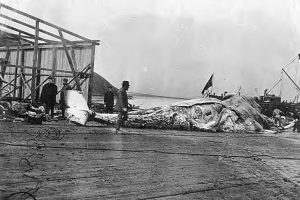
Alaskan dockside scene, circa 1911.
Source: Wikimedia Commons

Dig a little deeper into history and the lighting fuel of choice was whale oil, initially processed in dockside refineries around the world, later produced on board ship as whaling vessels became large enough to accommodate the necessary equipment and tankage. From being a rough and ready battle with nature and the elements, fraught with danger for the dinghy crews, whaling became an increasingly ruthless war of attrition that drove whole species to the brink of extinction. As well as extracting all the oil from a huge carcase, the whaling industry earned substantial money from whale meat, with some cuts sold on for cheap food products and the rest sold to feed urban cats and dogs. In this context, the dog’s dinner was a secondary by-product from the days of lucrative barrels of whale oil.The whaling industry went into a long term decline as a direct result of its impact on whale numbers.

Forging urban food chains

France in the closing years of the 18th century was in total chaos. The Terreur (terror) reached its height with the execution of the Jacobin leader Maximilien Robespierre in the summer of 1794. In the years that followed, the Consulate took control led by Napoleon Bonaparte. The young Napoleon set himself the task of clearing away all the old laws and the rag-bag collections of local regulations (“coutumes”).  He replaced them with the “Code Civile” that set out the rules for a constitutional reset.

The code was secular and written in ordinary French. It detailed what was expected of citizens — considering men to be equal before the law, while assigning women the role of dowry-bearers, facilitating the transfer of property and assets between families. Because of the contractual importance of marriage, there were elaborate requirements to ensure that men were legitimate before they could be married. The husband owned his wife’s dowry, but not her paraphenalia.

The code also laid out commercial frameworks and set standards for product liability. For instance, artisans and craftsmen were required to give a ten-year guarantee on their work. When selling land, sellers were obliged to include the oxen teams and equipment needed to work the land. And those acquiring livestock with a farm were required to keep the animals exclusively on that farm, keeping the dung on the holding. It is worth remembering that rural France was heavily  populated in those days, but over the coming century, this was about to change. The Code applied to both town and country, as well as to those on their travels. For example, innkeepers had a legally enforceable duty of care for their guests’ goods and chattels, which extended to those working on the premises, protecting them, too, from light-fingered interlopers.

The March 1804 version of the Code Civile had more than 1800 paragraphs and was the largest version to be put up for adoption. There were prolonged debates about all three circulated versions, each with different numbering and paragraph counts. Some of the articles in the Code Civile still apply to this day, often heavily modified. The administrative commitment to a document-based system put a greater priority on literacy. Deaf or visually challenged citizens who could read had protected access to the provisions of the code unlike non-readers who made their mark to sign off  documents they could not read.

Between a rock and a hard place

Hampshire tenant farmer Oliver Neagle was forced to cull 18 of his cows after water supplies to his farm were cut. The dairy farmer pays for water as part of his rent, however he endured breaks in his supply in December and February. Southern Water laid on bottled water for consumers, but had no solution to offer Neagle’s livestock. The number of lactating cows on his farm has gone down from 110 head to 82. With fewer milking cows, the business is compromised and faces harder times. You can read the BBC’s account of what happened here.

This story is an example of the sort of public interest reporting carried out by local BBC journalists that would not have had any traction for commercial broadcasters. Neagle’s story must not be allowed to go down the back of the sofa, no more than the importance of fearless public sector journalism should be undervalued or misunderstood. 

Eggs by rail

pic Bo Jess om, Wikimedia Commons

The common sense, sturdy construction of this wooden egg crate and thousands like it ensured that once the eggs had been wrapped with a layer of crepe paper, they were good for journeys across Europe. France, Holland and Denmark all exported eggs to England in the latter half of the 19th century and on into the 20th.

Skip to toolbar