Urban Food Chains

the links between diet and power

Advertisement

British pigs overlooked in Brexit preparations

Urgent requests for government involvement in setting up the commercial infrastructure that would be needed for trading as a third country after Brexit were mostly ignored, according to pig industry body the National Pig Association (NPA). In November 2020, with less than two months before the end of the transition period, the association had “…a long list…” of unanswered procedural questions for the export of breeding pigs and pork products after Brexit.

While the NPA continued to work closely with the environment ministry DEFRA, NPA chief executive Dr Zoe Davies warned that: “…time is now running short and we need more urgency and engagement from across Government before it is simply too late.”

She observed that the UK pig sector faced the very real prospects of being unable to continue the vitally important trade in breeding stock to the EU and of severe delays, as well as higher costs and reduced market access for pork exports. “The impact could be devastating,” she warned.

Some of the unanswered questions required solutions regardless of whether or not there was a Brexit agreement in place after the transition period. Topping the list was a lack of Border Control Post (BCP) facilities in key European ports for live pigs and in some instances pork products. Once the grace period ends for customs health checks on imports, serious doubts persist about the availability of qualified veterinary professionals to process a tidal wave of additional certificates. The NPA estimates that the paperwork alone will increase fivefold.

“We are still waiting for an indication of whether or not the significant extra veterinary resource required can be met,” explains Davies. In 2020 DEFRA told the NPA to persuade the key EU port authorities to invest in the necessary BCP facilities and left the association to its own devices. “There has been no interest from the Government in helping us engage at either Commission or Member State level.”

The required investments in BCP facilities will also be required for consignments arriving in the UK once the transition period is over. “There are no seaport BCPs in the UK at present either,” explains Davies.

“Defra has pointed out that, as it is phasing in import checks, these won’t be needed until July 2021. However, we will need to know well in advance what the exact requirements will be for testing and inspection, while any port operating as a BCP will require time to put the necessary infrastructure in place.” The financial commitment involved is significant: it includes specialist veterinary staff appointments as well as buildings and laboratory facilities.

A further practical consideration that was still unresolved at the end of the transition period was transport. “Hauliers will require separate authorisations and qualifications in both the EU and UK. There is still a complete lack of clarity as to how companies will be able to register and hold multiple authorisations without adding huge cost.”

The operational impact on the slaughtering and processing sector of losing large numbers of qualified non-UK EU vets is not a new concern. The issue was raised in the House of Lords report number 15 published during the 2017-8 session of Parliament. (https://publications.parliament.uk/pa/ld201719/ldselect/ldeucom/15/15.pdf)

This post first appeared about 10 days before Christmas. Today, December 25, it is clear that the government has learnt nothing from this episode; there is a lingering temptation to suggest that this was the intention all along. More than 30,000 healthy pigs have been culled at the expense of pig producers up and down the country. Many of them have gone or will go out of business through business through no fault of their own.

British pig producers face oblivion

A 20% drop in the number of skilled butchers working in British abattoirs and boning halls has led to a 25% fall in the number of pigs being bought in by the slaughtering sector. The result is that British pig farmers are running out of room to keep unsold pigs and face the prospect of culling thousands of healthy animals.
The National Pig Association chief executive Zoe Davies is already warning that most of the British pig industry will be out of business by next summer. From its conversations with members, the NPA can confirm that at least 16,000 healthy pigs have already been culled in recent weeks, but the figure is almost certainly the tip of a very grisly iceberg.

The UK government has offered support packages for the processing sector in a bid to restore slaughtering capacity but none of this will stop pig farmers going out of business. Farming minister George Eustice is on the record saying that he can’t see what else he can do that might help pig producers stay in business.
NPA ceo Zoe Davies is frustrated by DEFRA’s lack of  foresight. “If that’s the way they want it, then that’s the way it will go. We will just see droves of people going out business, there won’t be a British pig sector going forward, or it will be massively reduced, and we will just end up importing all the product from European Union.”
Davies estimates that the pig crisis cost producers GBP 130 million during the first six months of 2021 and she is seeing farmers leaving the pig sector and farming.

The operational impact on the slaughtering and processing sector of losing large numbers of highly qualified non-UK EU staff is not a new concern. The issue was raised in the House of Lords report number 15 published during the 2017-8 session of Parliament. (https://publications.parliament.uk/pa/ld201719/ldselect/ldeucom/15/15.pdf)

Dietary gold on trees

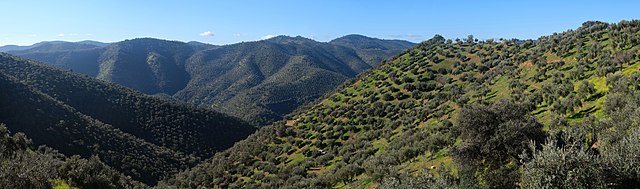
pic Wikimedia Commons

Today (Friday November 26) is World Olive Tree Day, as growers in the northern hemisphere prepare to pick the next crop of olives. More than two thirds of the world’s olive trees grow in the Mediterranean basin and survive thanks to their deep roots. Younger trees planted in more recent groves will often be irrigated until their roots have reached cooler, damp rock formations.

Olive oil ranges in colour from green to gold.

Olives are a winter crop: starting in November unripe green olives are gathered and pressed for distinctively strong, green oil. As the winter progresses, the olives darken and ripen, the oil changing to gold as the flavour softens with the fruit. The harvest continues into February and March, depending on varieties and locations.

Traditional olive-picking techniques needed the olives to be hard enough not to break up as pickers beat the trees with heavy sticks. Today, large groves are harvested with a mechanical arm attached to the trunk of the tree. The tree is then shaken vigorously, emptying the fruit onto large sheets spread out to catch the crop. The process is stressful for the tree, but is quicker than the stick-wielding villagers. The remaining winter months are a time of recovery.

Once picked, olives are fragile. Away from the tree, the olives start to accumulate free oleic acid as they oxidise during the different stages of processing. Only when the oil is extracted and stored under nitrogen can the oxidation be halted. The largest pressing plants, typically in Spain, where batches are consolidated and have more time to oxidise, face the prospect of minimising the effects as best they can.

Olives picked for the table have an additional constraint: unlike olives bound for pressing, every table olive needs to be visually perfect. To remove the stones from olives, the flesh needs to be firm and the olive must be unripe. To produce black pitted olives, green olives are treated to make the flesh black and then the stones can be removed mechanically. By the time an olive has fully ripened and turned black naturally, it is no longer possible to remove the stones mechanically, since the soft flesh just falls apart. The taste, however, is exquisite.

Olive oil grades

Olive oil is a highly-prized commodity, for a very wide range of reasons. As a key ingredient of many elements in the Mediterranean diet, it is a pivotal component of Mediterranean cuisine. Across the region, household use of olive oil would be counted in dozens of litres a year.

Spain is the world’s biggest producer and user of olive oil: collectively, domestic consumers buy tens of thousands of tonnes every month. The country usually produces over a million tonnes of olive oil a year, much of it shipped to packers all around the world.

Greek olives are harvested in small quantities and pressed within hours of coming off the tree. Domestic Italian production is an even lower tonnage. Italian blenders are very skilled at procuring the right mix of flavours and colours of oil from all over the world to blend in bulk. The bottles were often marked “Prodotto in Italia” (“produced in Italy”) but this delightfully vague ambiguity was outlawed by the European Commission.

Pressing yields anything up to 20% by weight in oil. This ranges from the cheap and cheerful institutional canteen cooking oil, olive pomace oil, through to single estate, single variety specialist extra virgin olive oils containing less than 0.08% in free oleic acid. Like wine, the estate bottled oils are like an exclusive club: they are as distinctive as the groves they came from.

The next grade, virgin olive oil, will have less than 2% free oleic acid, which will be reflected in the taste. The different grades of virgin olive oil are too delicate to be suitable for deep frying, which is the main use for olive pomace oil. Pomace is the paste that is left over from the mechanical pressing process used to extract virgin oil grades. Due to its lower moisture content, olive pomace oil is better suited to high temperature applications.

Animal, vegetable, mineral

These three words help us to navigate the arcane world of customs codes, which do in fact follow logical rules. The underlying structure is called the Harmonised System. This is made up of groups of traded commodities, referred to as chapters which add up collectively as a schedule. Merchandise is listed in the order animal, vegetable and mineral.

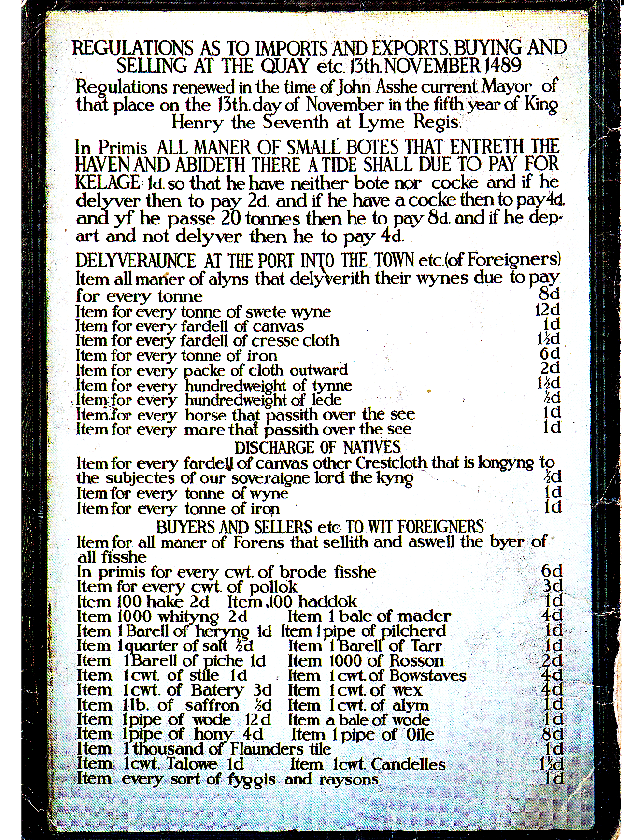
The first part of the Constitutio Renovata (reformed regulations) displayed on a board at the port in Lyme Regis, dated 1489. It lists the harbour charges and duty for goods unloaded there.

The opening chapters cover live animals, followed by carcases and meat, moving on to animal products. Animals are followed by fish. Plants come next and are similarly classified in the order of seeds, then plants followed by retail fruit and vegetables.

A guide to the detail of customs classifications is in preparations and will be downloadable from this page in the coming weeks.

Settling down

Reading the preface of James C Scott’s book Against the Grain, I realised that it promises to live up to my expectations. Scott disentangles the timelines of settled agriculture, which is only possible with domesticated crops and livestock. The process of domestication was spread over millenia in the region between the Tigris and the Euphrates, starting around 8000BCE. Domestication was an essential step on the way to settling in a fixed location.

Establishing crop-fields attracted species that were later domesticated.

Establishing permanent crop-fields attracted wildlife such as ducks and other fowl that could, like fire or food crops, also be domesticated. Scott argues that the process of domestication is reciprocal, since humans adapted in subtle ways to the livestock they wanted to keep.

There is a lot of detail to absorb, so it will be a while before I return to discussing his analysis of the history of the region that later became Mesopotamia and Sumeria. Scott is published by Yale University Press.

Hand to mouth

Pic by Sven Rosborn: public domain.
Tollund man, photographed in 1950 by Sven Rosborn. Public domain.

Meet Tollund man, whose body was recovered from a peat bog in Denmark in 1950. His face is one of a handful to have survived down the centuries from an age when finding food in Europe was a constant struggle. The cadaver was so well preserved in the sphagnum moss that scientists have had an opportunity to investigate Tollund man’s last meal.

This was a rough gruel made from seeds and grain, including barley, flax and common knotweed. There is no way of knowing whether Tollund man ate as frequently as once a day, but every last morsel of food came from his immediate surroundings.

There was no question of exotic or imported food reaching such a humble soul. This may strike us as strange since we live in a world where foods of all descriptions travel halfway round the world. We need to recognise that Tollund man had marginal existence rather than a sustainable diet. How he survived is a mystery to us in the twenty first century, but we are about to relearn the skill set or perish in the attempt. The plants Tollund man harvested can still be found at certain times during the year and these harvests will reclaim their relevance to our times, probably within our lifetimes.

We should not think of Tollund man as a survivor in a hostile environment that has long since been domesticated but recognise that this former denizen of the wild prehistoric lowlands has a lesson for us. Regardless of how he met his end, Tollund man lived by foraging and had skills that we are likely to need once more.

What makes an English breakfast?

The first shipment of Danish bacon arrived in October 1847. Through the nineteenth century, Denmark used to export wheat to Britain, but North America’s railway network reached the east coast in the 1840s and generated a tidal wave of cheap grain across Europe. Like the rest of its European neighbours, Denmark was unable to compete with transatlantic prices and turned instead to converting American grain into eggs, dairy products and bacon. At this time, the whey left over from cheesemaking was fed to pigs, who can put on 100 grams a day to their body weight.

Throughout the nineteenth century, Danish agriculture underwent a transformation in which livestock cooperatives flourished, especially those raising pigs. In 1887, Germany banned imports of Danish pigs and bacon, which pushed the cooperatives to increase the volumes of bacon shipped to the UK. It is worth remembering that without universal refrigeration, pigmeat had to travel as salt pork or bacon.

Amber light for greens

UK fresh produce wholesalers were among the first adopters of end-to-end database-driven stock management. In the early 90s, when multiple retailers were rolling out electronic Point Of Sale systems, overnight there was enough reliable data to drive ordering and procurement systems.

To maintain year-round availability of core inventory, wholesalers needed to be very granular in what constitutes an SKU. By the standards of the day, the databases they developed were ahead of their time. By around 1994, one wholesaler was tracking product grades by (16-bit) colour, calibration range, farmgate and dockside Brix, crop/season dates, with regional adjustments for weather bringing seasons forward or holding them back.

The SKUs were effectively large matrices, with a very long tail of incremental detail that went far beyond grower details and crop varieties. The database effectively became the business and was stored in triplicate on hard drives that were lodged in rotation with the bank: one active, two off-site, rotated daily.

With a global reach, shiploads of third country fresh produce were being sold while the goods were still on the water. Title remained with the consignee until after the ship had docked and unloaded.

For third country fresh produce, the transition from the Common European Tariff to the UK Global Tariff is a detail for which the variables are knowable in advance. For third country produce, the UK already has the PEACH system (Procedure for Electronic Application for Certificates) which is run by DEFRA. Visit https://www.gov.uk/guidance/automatic-licence-verification-between-defra-rpa-and-hmrc where you can download a spreadsheet that maps CN numbers on to plant varieties and gives handling details for importers. The back end of PEACH is currently plumbed into TARIC-3, so a UK-based replacement  is doubtless in hand.

Import duty on imported fresh produce can be agreed on the  basis of a Method 4 valuation, agreed by HMRC (https://www.gov.uk/government/publications/fresh-fruit-and-vegetables-under-method-4-valuation). EU-grown fresh produce should be transferable to this method when the time comes, as the need arises.

Skip to toolbar